



Your curated wrap-up from The Southeast Asia Desk.
Hello and welcome back,
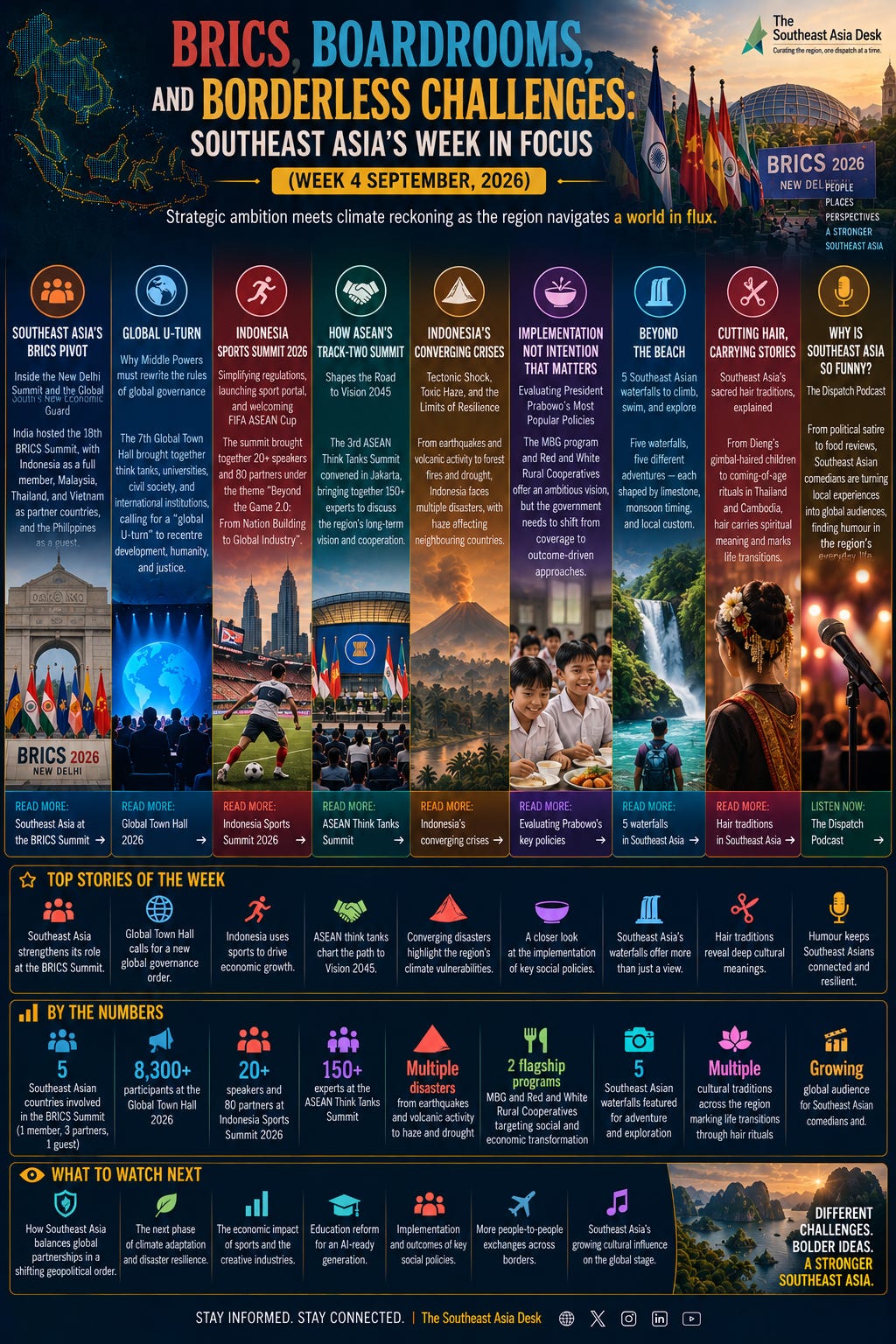
This week, Southeast Asia finds itself at the centre of a global realignment. The BRICS Summit in New Delhi cemented Indonesia’s place as the region’s only full member of the bloc, while Malaysia, Thailand, and Vietnam deepened their partnerships.
In Jakarta, the Global Town Hall brought together over 8,300 participants demanding a “global U-turn”, a fundamental reordering of international rules.
Meanwhile, Indonesia is betting on sports to drive economic growth, ASEAN’s think tanks are charting the path to Vision 2045, and the archipelago is confronting converging disasters from earthquakes to toxic haze.
And through it all, Southeast Asians are finding reasons to laugh.
Here is your news in focus.
🇮🇳 Southeast Asia’s BRICS pivot: Inside the New Delhi Summit and the Global South’s New Economic Guard
India hosted the 18th BRICS Summit on 12-13 September in New Delhi, under the theme “Building for Resilience, Innovation, Cooperation and Sustainability”. Five Southeast Asian countries were involved: Indonesia as a full member (joined January 2025), Malaysia, Thailand, and Vietnam as partner countries, and the Philippines as a guest following its role as ASEAN Chair.
Read more:
https://www.thesoutheastasiadesk.com/p/southeast-asia-brics-summit-2026-new-delhi
🌐 Global U-Turn: Why Middle Powers must rewrite the rules of global governance
The seventh edition of Global Town Hall, held on 19 September, carried the theme “Calling for a Global U-Turn: Recentering Development, Reclaiming Humanity, Restoring Justice in a Crazi(er) World”. The event brought together think tanks, universities, civil society organisations, and international institutions for a virtual forum on the state of the world.
Read more:
https://www.thesoutheastasiadesk.com/p/global-town-hall-2026-fpci-middle-powers
🏃🎪 Indonesia Sports Summit 2026: Simplifying regulations, launching sport portal, and welcoming FIFA ASEAN Cup
The Indonesia Sports Summit 2026, held from 11-13 September at the Jakarta International Convention Centre, brought together more than 20 speakers and 80 global and national partners under the theme “Beyond the Game 2.0: From Nation Building to Global Industry”.
Read more:
https://www.thesoutheastasiadesk.com/p/indonesia-sports-summit-2026-fifa-asean-cup
🌏🤝 How ASEAN’s Track-Two Summit Shapes the Road to Vision 2045
The 3rd ASEAN Think Tanks Summit (ATTS) convened on 14 September 2026 at the ASEAN Secretariat in Jakarta under the theme “Navigating Our Future, Together”. Co-organised by the Singapore Institute of International Affairs on behalf of ASEAN-ISIS, the two-day summit brought together over 150 experts, research institutions, and international partners.
Read more:
https://www.thesoutheastasiadesk.com/p/3rd-asean-think-tanks-summit-vision-2045
🌋 Indonesia’s Converging Crises: Tectonic Shock, Toxic Haze, and the Limits of Resilience
Indonesia is facing a series of disasters, from earthquakes and volcanic activity to forest and land fires and drought expected to persist into 2027. The resulting haze has affected neighbouring countries, with Malaysia and Brunei raising the issue at the ASEAN level.
Read more:
https://www.thesoutheastasiadesk.com/p/indonesia-converging-natural-disasters
🍽️ Implementation Not Intention That Matters: Evaluating President Prabowo’s Most Popular Policies
President Prabowo Subianto’s Makan Bergizi Gratis (Free Nutritious Meals, MBG) program and Koperasi Desa/Kelurahan Merah Putih (Red and White Rural Cooperatives) represent an ambitious vision of a more socially responsive Indonesian state. The government needs to shift from a coverage-driven model to an outcome-driven approach where nutritional improvement, food safety, targeting accuracy, and local economic impact become central performance indicators.
Read more:
https://www.thesoutheastasiadesk.com/p/indonesia-prabowo-mbg-digital-food-subsidy-cooperatives
🌊 Beyond the beach: 5 Southeast Asian waterfalls to climb, swim, and explore
Southeast Asia’s waterfalls are not interchangeable. Limestone, monsoon timing, and local custom have shaped each one into something you do, not just look at. Five waterfalls, five completely different days out. One you climb, one you swim, one you earn, one you raft, one you wait for.
Read more:
https://www.thesoutheastasiadesk.com/p/5-southeast-asian-waterfalls
✂️ Cutting hair, carrying stories: Southeast Asia’s sacred hair traditions, explained
From Dieng’s gimbal-haired children to coming-of-age rituals in Thailand and Cambodia, hair carries spiritual meaning and marks life transitions.
Read more:
https://www.thesoutheastasiadesk.com/p/dieng-culture-festival-southeast-asia-hair-rituals
🎙️ The Dispatch Podcast: Why Is Southeast Asia So Funny?
From political satire to food reviews, Southeast Asian comedians are turning local experiences into global audiences. This week’s podcast explores how comedians across the region make jokes about what it’s actually like to live in Southeast Asia—not explaining the region to outsiders, but finding the absurdity in everyday life.
Listen here:
https://www.thesoutheastasiadesk.com/p/s26e33-why-is-southeast-asia-so-funny
✍️ Closing Note
This week’s stories reveal a region asserting its place in a shifting global order, not as a passive recipient of rules written elsewhere, but as an active shaper of its own future.
From the BRICS Summit in New Delhi to the Global Town Hall in Jakarta, from the sports industry ambitions to the think tank corridors of ASEAN, Southeast Asia is building the institutions and alliances that will define the next decade.
Yet the week also brought sobering reminders of the region’s vulnerabilities: converging natural disasters, the recurring haze crisis, and the gap between policy intention and implementation.
Through it all, Southeast Asians continue to find humour in the absurdities of daily life, perhaps the most enduring form of resilience.
Thank you for reading.
✨ Stories to linger over, one week at a time.
(ELS/QOB)